Available on Amazon Kindle

Understanding
Electronic Signatures

European Regulation

Carlo Tenca’s handbook for navigating Europe’s electronic-signature legal framework: eIDAS, the eIDAS 2.0 reform and the arrival of the European Digital Identity Wallet. A practical guide, written by someone who has done security in the field.

Kindle Edition
122 pages
Published April 26, 2026
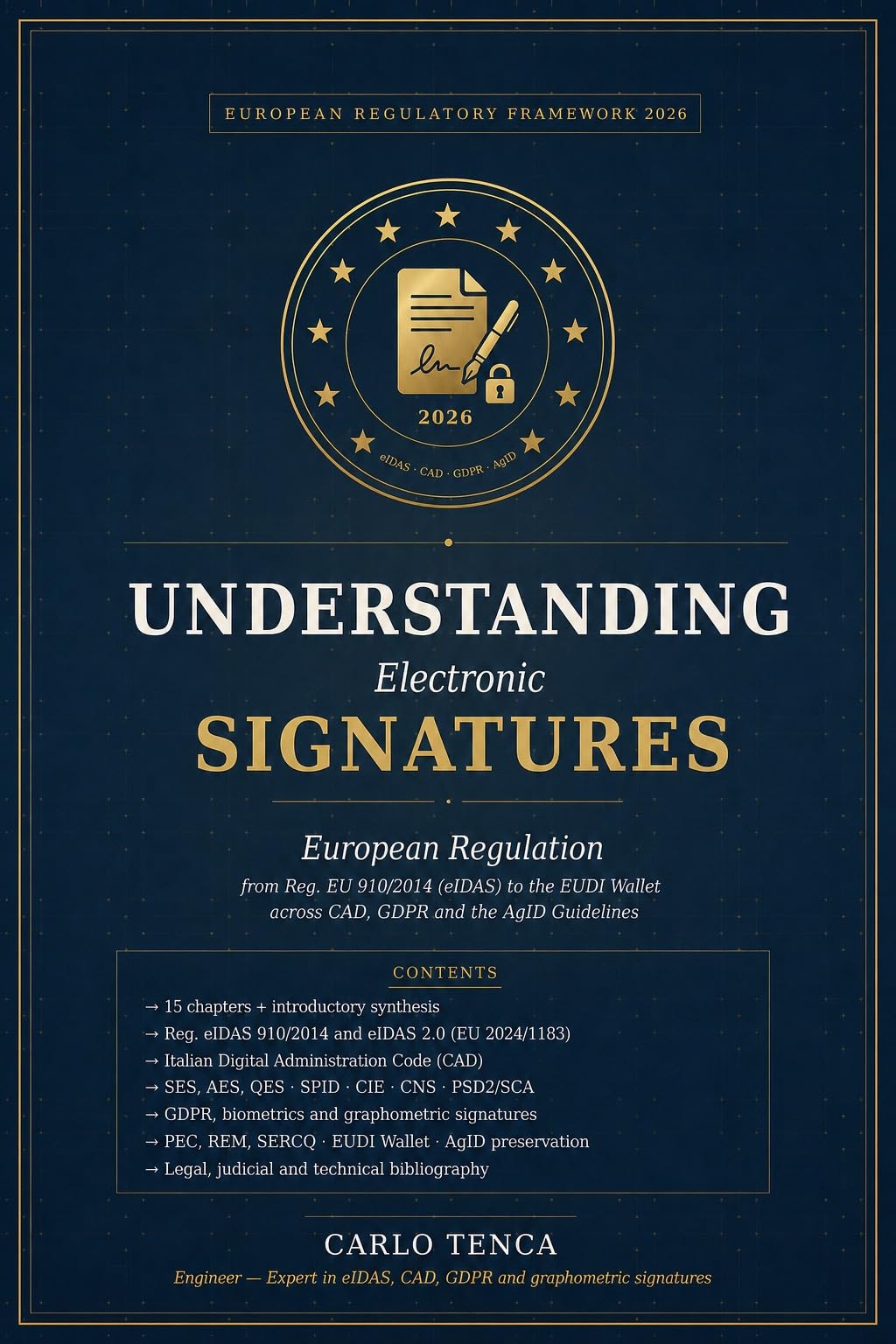
Official cover of the book “Understanding Electronic Signatures: European Regulation” by Carlo Tenca
Why this book

Everything you need to know about eIDAS

From the 2014 regulation to the 2024 reform, from national eID schemes to the European Digital Identity Wallet: a single text to navigate the framework with no blind spots.

01

Unified legal framework

EU Reg. 910/2014 and EU Reg. 2024/1183 explained with tables, schemas and concept maps.

02

SES, AES, QES

The three categories of electronic signature: legal differences, use cases and probative value.

03

EUDI Wallet

The European Digital Identity Wallet: architecture, attributes, credentials and rollout timeline.

04

Operational landscape

National eID schemes, supervisory bodies and Trust Lists: how Member States implement the Regulation.

Table of contents

Ten chapters, one complete map

Each chapter blends regulatory framing, case-law references and operational checklists. Designed to be consulted as a handbook, written to be read as an essay.

  1. From handwritten to electronic signatures

    The legal value of a signature. Why digital required a new paradigm of evidence and trust.

    Foundations
  2. The eIDAS Regulation (910/2014)

    Architecture, definitions, actors, qualified trust services. The first pillar of European digital identity.

    Reg. 910/2014
  3. SES, AES, QES — The three signatures

    Simple, advanced and qualified electronic signatures: requirements, probative value, legal presumptions.

    Taxonomy
  4. Seals, timestamps and electronic delivery

    The other qualified trust services: QSEAL, QTSP, eDelivery, long-term validation.

    QTS
  5. Digital identity and notified schemes

    Notified eIDs across the EU. Cross-border recognition and the eIDAS node.

    eID
  6. eIDAS 2.0 — What Reg. 2024/1183 changes

    The 2024 reform article by article: new obligations, new safeguards, new players.

    Reg. 2024/1183
  7. European Digital Identity Wallet

    Architectural Reference Framework, ARF 1.x, use cases, attributes, verifiable credentials.

    EUDI
  8. Compliance and the lifecycle of a signed document

    PAdES, CAdES, XAdES, JAdES formats; validation; long-term preservation.

    Technical
  9. National implementation: a closer look

    How Italy implements eIDAS — a case study on the dialogue between EU and national law.

    Member States
  10. Frontiers and outlook

    Blockchain anchoring of evidence, generative AI, anti-deepfake, European digital sovereignty.

    Future

The electronic signature is not a digital imitation of a handwritten one. It is a new legal act, founded on the mathematics of cryptography and on institutional trust. Understanding this changes the way we read contracts, judgments and identity itself.

From Chapter 1

Who it is for

A book for those who decide, design, review

Lawyers and in-house counsel

Legal clarity on validity, evidentiary value and challenges to electronic signatures.

  • Presumptions under Reg. 910/2014
  • Relevant EU and national case law
  • Model contractual clauses

IT leaders & CISOs

Architecture, integration, QTSP selection, validation and preservation processes.

  • European Trust List
  • Formats and libraries
  • Threat-modelling templates

DPOs and compliance officers

Alignment between eIDAS, GDPR and Reg. 2024/1183. A map of obligations across document workflows.

  • Privacy by design
  • Compliance audit checklists
  • Required documentation

Public sector

National eIDs and the EUDI Wallet: how citizen services are migrating across the EU.

  • National implementation
  • Cross-border services
  • Adoption timelines

Notaries and accountants

Operational tools for digitally signed deeds, expert reports and financial statements.

  • SES, AES, QES applied
  • Public electronic acts
  • Co-signatures and counter-signatures

Students and researchers

A reference text for courses in IT law, security and digital identity.

  • Curated bibliography
  • Legal-technical glossary
  • Discussion questions
About the author

A voice that has spoken security for over twenty years

Carlo Tenca, Eng.

Founder of RAVENG · Inventor of FirmaCDC

An engineer with over twenty years of experience in industrial safety and cybersecurity, Carlo has led safety and security programs for leading Italian manufacturing groups. With RAVENG, the integrated-security division of CE4U S.r.l., he has brought a critical-security mindset to the world of digital signing, patenting the FirmaCDC technology.

This book distils years of consulting, audits and standards work: a practical compass for those who can’t afford to get it wrong, written by someone who has seen electronic signatures truly in action.

Engineer Patent Holder RAVENG Founder CE4U S.r.l.
Editorial details

A volume crafted in every detail

Format
KindleeBook
Pages
122print length
Language
EnglishItalian edition available
ASIN
B0GX2QBGVWAmazon identifier
Published
Apr 26, 20261st edition
Author
C. TencaRAVENG · CE4U
Frequently asked

What you may want to know

Where can I buy the book?
On the Amazon Kindle Store: amazon.com/dp/B0GX2QBGVW. The book reads on any Kindle device, on the Kindle apps for iOS / Android / Windows / Mac, and in any browser via Kindle Cloud Reader.
Is it already aligned with eIDAS 2.0?
Yes. The book incorporates Regulation (EU) 2024/1183, which entered into force in 2024, and accounts for the EUDI Wallet implementing acts and Architectural Reference Framework documents published up to Q1 2026.
Is it a technical or a legal book?
Both. Each chapter is built on two layers: a legal track with precise references to EU and national positive law, and a technical track with diagrams, formats, processes and references to ETSI/CEN standards.
Is there an Italian edition?
Yes. The Italian edition, Comprendere la Firma Elettronica: Normativa Europea, is available in parallel. Visit the Italian edition page or open it directly on amazon.it/dp/B0GX31YN3B.
Can I adopt it as a university textbook?
Absolutely. The book is also designed as a reference for courses in IT law, security and digital identity. For academic adoption, please write to c.tenca@raveng.it.
Available now

Open the book. Shift the perspective.

One hundred and twenty-two pages to read the electronic signature the way the law actually reads it. From the theory of Reg. 910/2014 to the wallet you’ll be asked about tomorrow morning.